Building a Lead Generation and Fulfillment System for Services
How I connected a content website with a custom operations platform that captures customer demand, matches leads with independent providers, manages fulfillment, and tracks referral fees.
In its first five weeks, a repair referral service I run handled 36 customer requests, 57 possible customer-provider matches, 60 providers approached, 15 customer go-aheads, and three completed jobs. The economics are not yet proven, but the complete workflow is now visible and measurable.
Getting the leads turned out to be the easier half. Every request then had to become a completed job, and that needed a different product.
The system has two layers. A content website attracts people with broken, out-of-warranty equipment. The content is written to be found through traditional search and to be usable by AI answer tools. If an article cannot resolve their problem, they can submit a request for help.
The operations platform takes over from there. It qualifies the request, finds a suitable independent repair provider, introduces both sides, tracks their conversation and next actions, records whether the work was completed, and tracks the referral fee.
The provider prices and performs the work. I do not handle the equipment, set the repair price, or hold inventory. When a referred job is completed, the provider pays a fixed referral fee.
For the customer, the product creates a path from an equipment problem to a relevant provider. For the business, it connects customer acquisition, provider matching, service fulfillment, and payment in one measurable workflow.
I built the two layers differently. The website was shaped around the questions customers search for. The fulfillment platform evolved from an outreach CRM as real requests exposed what the operation actually needed.
Identifying details and wording have been generalized to protect the customers and providers involved. The screenshots use placeholder names and hide fee amounts.
One system, from discovery to payment
The product is not just a lead-generation website or an internal CRM. It is the path connecting discovery, demand, fulfillment, and settlement.
The benefit is one operating loop. A customer can move from a useful page to a real provider without the request disappearing into an inbox, while I can see what happened, who needs to act, and whether the commercial loop was completed.
Building the demand engine
The website is the acquisition layer. Instead of beginning with a directory of providers, I began with customer problems: the questions people ask when equipment fails, the symptoms they describe, and the information they need before deciding what to do next.
That content serves two purposes. It can answer the question directly, and it can identify demand that still needs a human service. Search-engine optimization helps the pages reach people already looking for those answers. Clear structure, direct explanations, and well-defined topics also make the material easier for answer engines to understand and cite. I covered the content side of that approach in Programmatic SEO with AI.
The request form converts that discovery into an operational signal. It shows which problems are common, which locations generate demand, and which requests are specific enough to act on. Thirty-six requests in five weeks proved that the website could create inbound demand. Better source-level attribution is still needed before comparing traditional search, AI referrals, and other channels reliably.
This changed the product question. Generating more leads was not enough. The service needed a reliable way to decide which requests could be fulfilled and move them toward an outcome.
Lead generation created a fulfillment problem
The fulfillment system began as a conventional outreach CRM. It assumed that the contact was the primary record, a reply was a success signal, and one pipeline status could describe the relationship. However, this stopped working when customers and providers became two sides of the same service. The CRM could store both parties, but it could not represent the work happening between them.
One customer might have a local provider, a mail-in option, and a backup. Each possible match can be waiting, declined, completed, or stalled independently. The real unit of work was therefore not the customer or provider. It was the route connecting them.
Every route now has its own introduction, conversation, waiting party, outcome, and possible fee. The referral view turns those routes into a working queue:
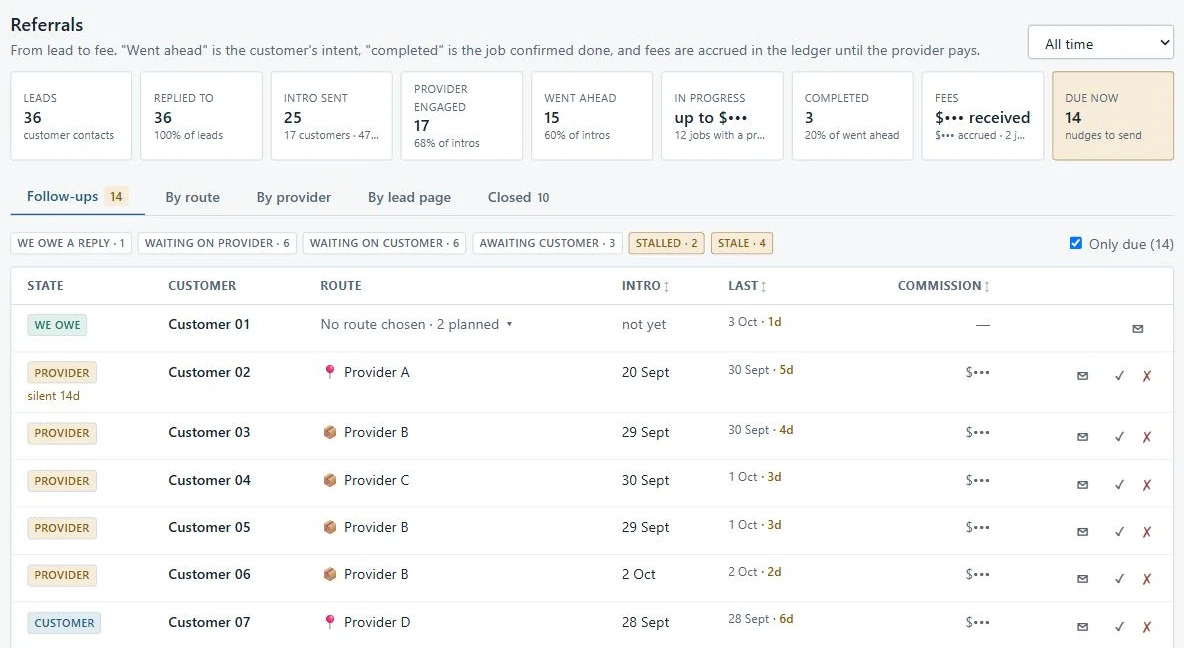
The route view shows the next action and commercial outcome for every possible customer-provider match.
That was a business-model decision expressed as a data model. Demand, provider capacity, matching, and settlement finally had somewhere to meet. It was also the next step in a system that began as a single-file outreach tool and later became a team CRM.
Live operations became product requirements
This is need-based development. I did not write the most useful requirements in advance. I put the system in front of real customers and providers, and each new use case found a place where it broke.
Every failure then became a specific safeguard: a rule the software enforces, a test that protects the rule, or a view that shows the problem before it repeats. Over time those safeguards formed a harness around the operation. The system is more reliable now because it failed early, on real work, while the cost of each failure was still small.
Introductions needed privacy boundaries
I once introduced a provider by replying to a customer’s existing email. The mail system included the previous conversation below my message, exposing private contact information to someone who had not been part of that thread.
Nobody complained. It was still wrong.
The CRM now turns a reply into a fresh message whenever a new party is added. It removes the old thread, explains why the rule applies, and protects the behavior with a test. Privacy became part of the workflow rather than a reminder for the operator.
Every route needed one next action
As the number of open cases grew, I could no longer tell who was waiting on whom. The CRM now derives a next-action state from the email history, identifies who spoke last, counts unanswered nudges, and surfaces overdue routes.
The useful question is no longer “Who is this contact?” It is “What needs to happen next on this route?”
Conversations needed to be readable
Several customer conversations appeared together on one provider record. Quoted history and missing author labels made the record hard to use, and some mail relays rewrote addresses or removed threading headers.
The CRM now groups messages by thread, collapses quoted history, and labels every author. When relay metadata is incomplete, it falls back to the known participant. A record is useful only if I can reconstruct what happened quickly enough to act.
Completion needed a settlement workflow
Completed work and outstanding fees initially lived in my head and inbox. The fix was a ledger with one row per referred job, fee due and fee paid stored separately, and a running balance per provider.
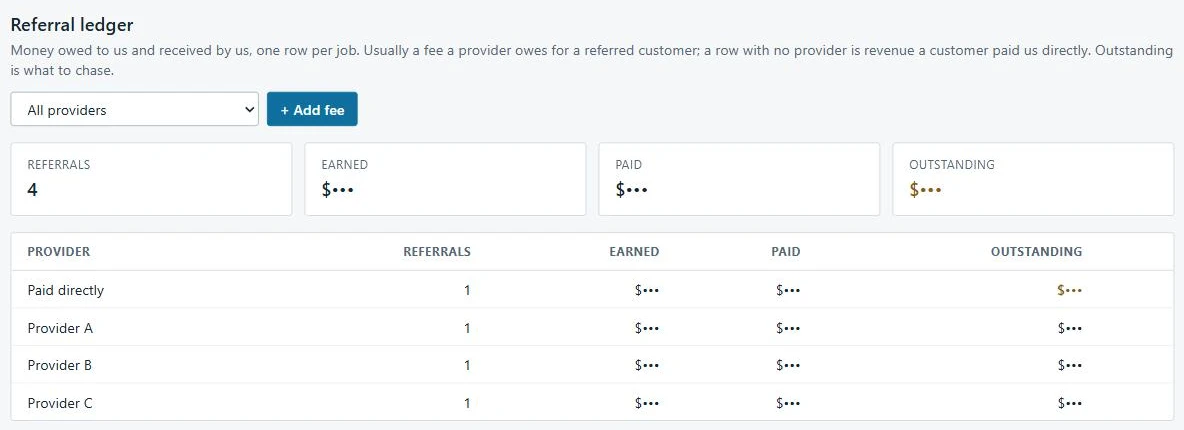
The ledger separates completed work, fees earned, and cash collected instead of treating them as one event.
A completed job is not the same as collected cash. Completion, fee accrual, and payment are separate events, and operational completion does not close the commercial loop.
Where software stopped helping
The system could show that a provider owed a reply. It could not make that provider want to answer an administrative message. From the provider’s perspective, a customer represents possible work while my request for an update or payment represents paperwork that can wait.
The first response was not more automation. I shortened provider emails to one question, put the question in the subject line, separated payment requests, agreed terms before the first introduction, and asked providers which communication channel they actually use.
Those rules now live in the template library, so each message type carries its own constraint:
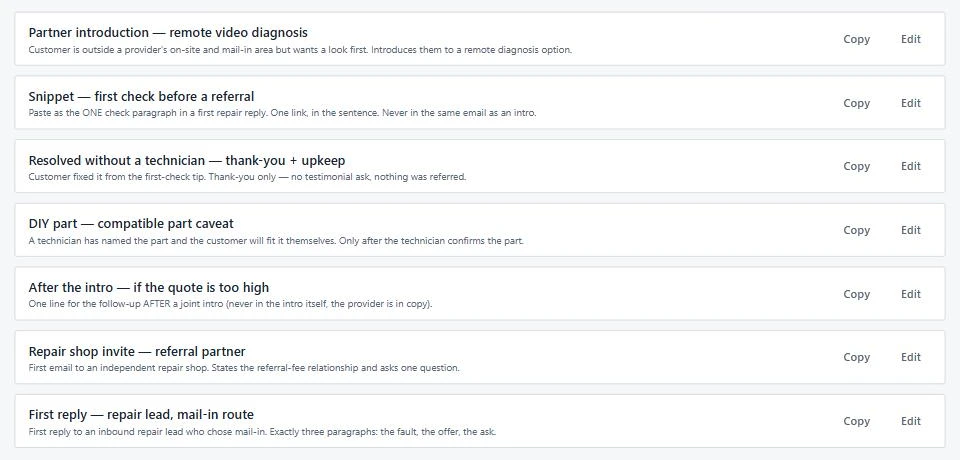
Each template states when to use it and what it must not contain.
Operating from Pakistan adds another practical constraint: some US providers expect a short text from a domestic number, while I have worked mainly through email and scheduled calls. I treat that as something to validate before building an SMS feature, not as a reason to add another channel immediately.
Provider communication also became operating data. Clear service boundaries, capacity, geography, customer-response time, closed-loop communication, and payment reliability all help describe the working relationship. Responsiveness alone does not prove technical quality, but it affects whether a route can be fulfilled reliably.
Fulfillment should shape acquisition
The website and operating system form a feedback loop. Incoming searches and requests reveal what customers need. Qualification shows which needs are actionable. Failed routes reveal where provider coverage is weak. Completed jobs and collected fees show which demand may be commercially worthwhile.
Coverage is the clearest example. When the only remote provider for one route type became unavailable, every customer needing that option lost a path forward. A service category with one provider is not durable coverage; it is a dependency. Grouping routes by type makes that gap visible:
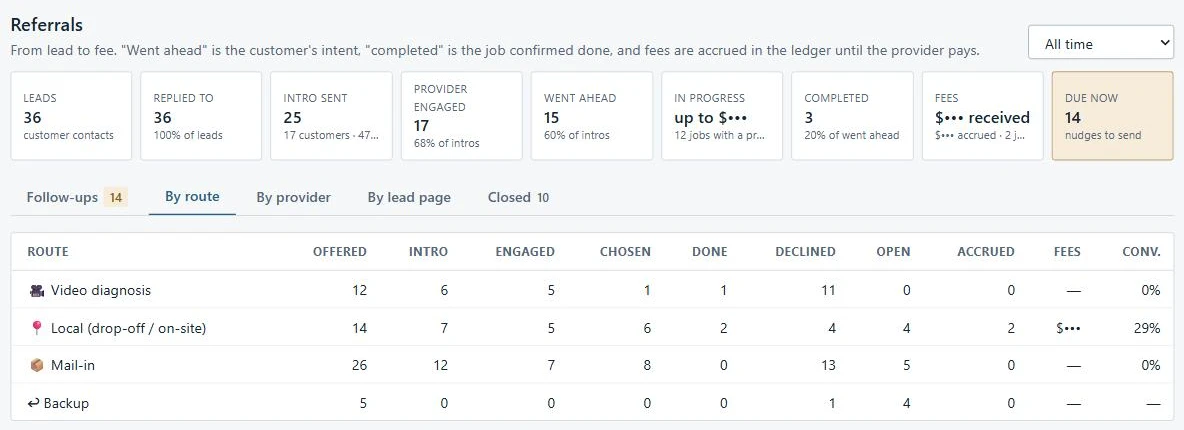
The by-route view compares coverage, engagement, and completion for each route type.
That means the acquisition system should not aim to generate every possible lead. Over time, it should focus content and conversion paths on the problems, locations, and service categories the provider network can fulfill well.
The reverse is also true. Repeated demand can justify recruiting another provider or opening a new route type. Acquisition informs supply, and fulfillment informs what demand is worth acquiring.
What five weeks validated
This is the early operating snapshot:
| Measure | Count |
|---|---|
| Repair requests received | 36 |
| Customer-provider routes offered | 57 |
| Introductions sent | 25 |
| Introductions where the provider engaged | 17 |
| Routes where the customer went ahead | 15 |
| Jobs completed | 3 |
| Referral fees collected | 1 |
| Providers approached | 60 |
| Providers with agreed terms | 6 |
| Emails handled per week, both directions | About 100 |
The evidence supports three conclusions: the website can produce genuine inbound demand, some providers will accept the commercial terms, and a managed introduction can lead to completed work. It also confirms that a route represents the fulfillment workflow better than one status on a contact.
The Insights view follows each customer from enquiry to completion so I can compare request types and locations without counting every route as a separate lead:
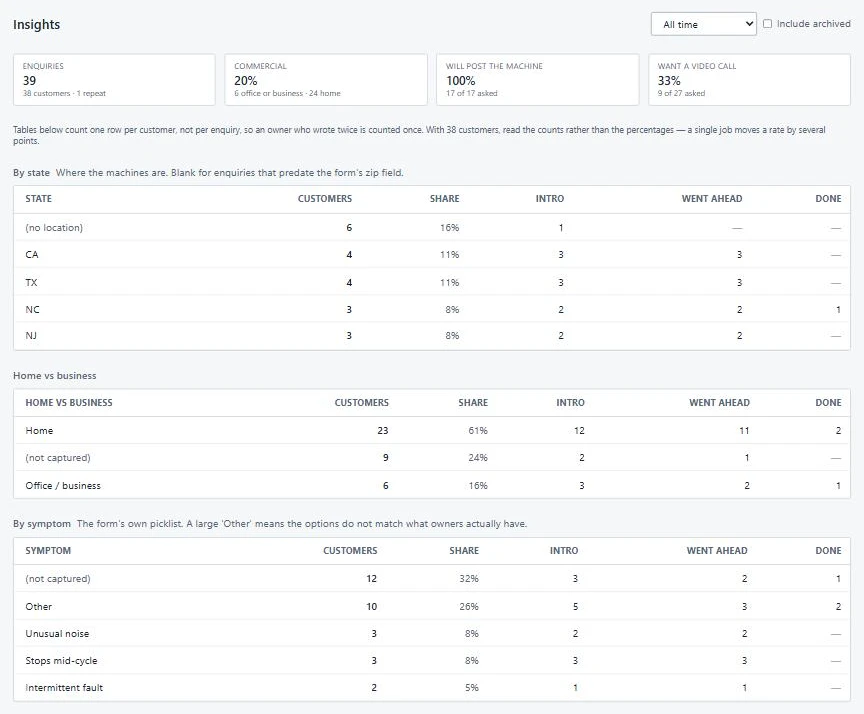
The Insights view connects acquisition segments with fulfillment outcomes.
What this project demonstrates
This was not simply a website, an SEO project, or a CRM rebuild. It required creating the path from customer discovery to service fulfillment, operating that path, translating failures into safeguards, and instrumenting it so each assumption could be tested.
That is the transferable pattern: generate qualified demand, understand the operation needed to fulfill it, build the smallest system that connects the two, and let real outcomes decide what to improve next.
Tags:
Kashif Aziz · Technical Consulting
Need to connect demand generation with service delivery?
I help service businesses build the acquisition layer, operating workflow, and custom software needed to turn customer interest into fulfilled work.