Halal Code Check
Case study: built Halal Code Check first as an E-code scanner, then evolved it toward a halal ingredient intelligence product with stronger onboarding, trust layers, behavioral analytics, and early foundations for a broader halal ecosystem.
TL;DR
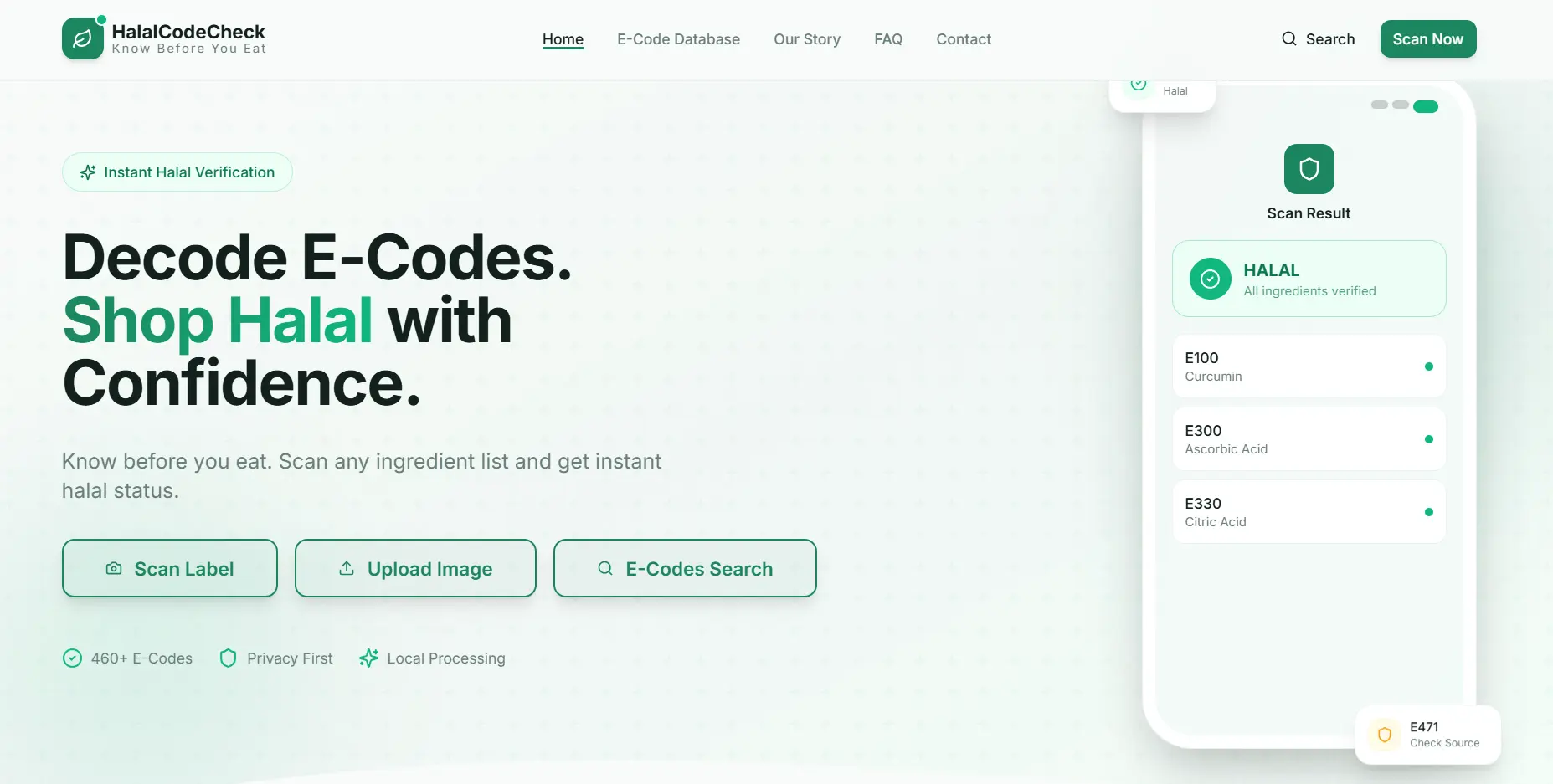
I built Halal Code Check first as a practical scanner to help Muslim consumers verify food additives quickly while shopping. After shipping that first version, I ran a focused product sprint to reduce first-visit confusion, improve trust signals, and instrument behavior so iteration is based on evidence. It still supports scan, voice, and manual lookup with local-first OCR and a curated 360+ E-code dataset, but the product is now evolving beyond scanning into a broader halal intelligence layer around ingredients, certification context, and market research.
The Problem
The initial product worked technically, but first-time users still needed more guidance.
Core friction points:
- Tiny ingredient text on packaging
- E-code labels that are hard to interpret under time pressure
- Uncertainty around what to check and when to trust a result
- Decision flow drop-off after viewing results
- Weak qualitative signal collection for roadmap decisions
Product Direction
This sprint shifted the product from a practical scanner and lookup tool toward guided decision support, while also moving it closer to a broader halal intelligence product:
- Build for real user uncertainty, especially first-time visitors
- Clarify outcomes and usage expectations earlier in the journey
- Close the loop: ship -> observe -> collect feedback -> iterate
- Use both analytics and stored qualitative input for decisions
Recent Sprint Updates
1. Homepage Reframed for New Users
- Repositioned copy and layout to assume no prior E-code knowledge
- Updated headline/subcopy around “before you buy” decision context
- Improved information hierarchy to explain product value faster
2. Trust and Credibility Layer Added
- Introduced a dedicated trust-proof block on the homepage
- Added clearer guidance language around expected outcomes
- Refined sensitive claims (including offline-related copy) for safer communication
3. Workflow Improvements Across Core Pages
- Strengthened “what to do next” pathways after results
- Moved feedback prompts closer to decision moments
- Improved interaction clarity, including stronger visual states for Yes/No feedback
4. Section-Level Analytics Instrumentation
- Added section-level event tracking to identify engagement and drop-off by block
- Extended tracking coverage to newly introduced feedback interactions
- Enabled practical CRO iteration based on observed behavior
5. Feedback System Expanded and Operationalized
Feedback capture (rating + optional comment) is now available on:
- Results pages
- E-code detail pages
- Food category pages
Feedback is persisted in Supabase, making it queryable for UX and content prioritization.
6. Abuse-Resistant Feedback Backend
Built secure persistence through RPC and server-side abuse checks:
- Cooldown/rate limiting
- Daily submission caps
- Duplicate detection via comment hash
- Basic spam and link-pattern protection
This keeps user input useful and reduces noise in qualitative data.
Current Product Experience
Halal Code Check supports three primary lookup paths:
- Scan mode: Users scan ingredient labels and extract E-codes via OCR
- Voice mode: Users speak E-codes for hands-free lookup
- Manual mode: Users directly search the database when they already know the code
The product then maps detected additives to halal status categories and guides next steps with clearer on-page decision support.
Coverage
- Curated database of 360+ additives (E-codes)
- Practical consumer-first scope over broad, unverified coverage
Architecture and Implementation
I kept privacy-first constraints while adding measurement and feedback infrastructure:
- In-browser OCR with Tesseract.js (no mandatory image upload for core scan flow)
- Explicit permission handling for camera and microphone usage
- Section-level analytics for behavioral insight
- Supabase-backed feedback storage for qualitative learning
- RPC-based feedback persistence with anti-abuse protections
Key Trade-offs
- Guided UX over minimal UI: more product surface area, lower first-visit confusion
- Stored feedback over event-only analytics: more backend complexity, better roadmap signal
- Abuse controls over frictionless submission: slightly stricter input flow, cleaner data quality
Why This Matters
These changes made the product:
- More understandable for first-time users
- More trustworthy at the moment decisions are made
- Easier to improve continuously through measurable usage and stored feedback
This is the operating model I use on product teams: ship quickly, instrument behavior, capture qualitative signal, and iterate with evidence.
Tech Stack
| Layer | Choices |
|---|---|
| Frontend | React 18, TypeScript, Vite, Tailwind CSS, shadcn/ui |
| OCR | Tesseract.js (in-browser) |
| Voice | Web Speech API |
| Data | Curated E-code dataset + Supabase feedback storage |
| Backend Logic | Supabase RPC with anti-abuse checks |
| Analytics | Section-level event tracking across core content blocks |
| Deploy | Cloudflare Pages |
Roadmap
- Expand trust-proof surfaces with stronger source-level context
- Use section analytics + feedback comments to prioritize highest-friction flows
- Continue improving conversion from result pages to confident action
- Add higher-confidence assisted lookup flows without weakening privacy defaults
Final Thoughts
Halal Code Check reflects how I build products:
- Start with a specific user pain point
- Make trust and clarity explicit in UX, not implicit in features
- Instrument behavior early so decisions are measurable
- Operationalize feedback so iteration stays grounded in real users
If you want to build and iterate a consumer product with strong UX fundamentals and evidence-based CRO, let’s talk.
Interested in building something similar?
I help founders ship privacy-conscious, production-ready products fast, from idea to deployed experience.